About this page...


You're now viewing the old Lundy Bird Observatory blogspot. Explore the new website for all your favourite island news and wildlife updates. If you have sightings to report, please consider sharing your observations or photographs with the Bird Obs team here.

Friday, 17 April 2020

14th to 16th Apr – Ring Ouzels, a Hawfinch – and an escaped Black Kite!

14th April

A nippy and windy day (easterlies again), particularly in the morning.

Highlights from what was a rather quiet bird day included a decent push of Swallow throughout, with 122 birds recorded – most of which were flying low down on the west cliffs.

It was also a good day for Ring Ouzel with three birds present: a female in Millcombe and a male and female together near Old Light. Some small flocks of Linnet too (73) were pushing on through the winds.

Female Ring Ouzel, near Old Light, 14 Apr © Dean Jones

Other sightings of note included four Woodpigeon, a single Snipe, the female Sparrowhawk, three each of Sand and House Martin, ten Blackcap, just three Willow Warbler, seven Chiffchaff, one Goldcrest, 20 Skylark, two Pied Wagtail, 74 Meadow Pipit, five Dunnock, three Robin, 47 Wheatear (including four more colour-ringed birds), six Blackbird, three Chaffinch and 11 Goldfinch.

15th April

A cool but beautiful spring day with moderate to light easterly winds.

A great day for migrants, particularly Swallow (312) and Wheatear (92), the latter of which included a number of Greenland-raced birds.

One of 92 Wheatears logged today, Benjamin's Chair, 15 Apr © Dean Jones

Additionally, the first Whimbrel of the year made an appearance below North Light in the afternoon, a male Ring Ouzel was hopping around the cliffs near Pilot’s Quay with a female Black Redstart, and a female Merlin was chasing Meadow Pipits and Linnets near Pondsbury in the late morning.

Black Redstart, near Pilot's Quay, 15 Apr © Dean Jones

Other sightings of note included 30 Manx Shearwater feeding off North End, the Quarters Water Rail, four Woodpigeon, the female Sparrowhawk again, a female Kestrel, eight Sand Martin, 38 House Martin, two Sedge Warbler, 12 Blackcap, 16 Willow Warbler, two Chiffchaff, two Goldcrest, 19 Skylark, four Pied Wagtail, three unraced alba wags, a single White Wagtail in Barton Field, 62 Meadow Pipit, ten Dunnock, three Robin, a female Stonechat, three Blackbird, four Song Thrush, three Chaffinch, 13 Goldfinch and 41 Linnet.

Non-avian sightings included five Harbour Porpoises off North End.

16th April

A lovely, warm spring day complete with blue skies, a light easterly wind and a good selection of migrants.

A beautiful spring day along the west coast, looking north from Dead Cow Point, 16 Apr © Dean Jones

Highlights included a female Hawfinch resting on the allotment wall after a run-in with the Pied Wagtail pair. The bird was seen again later in the afternoon foraging in Millcombe Wood.
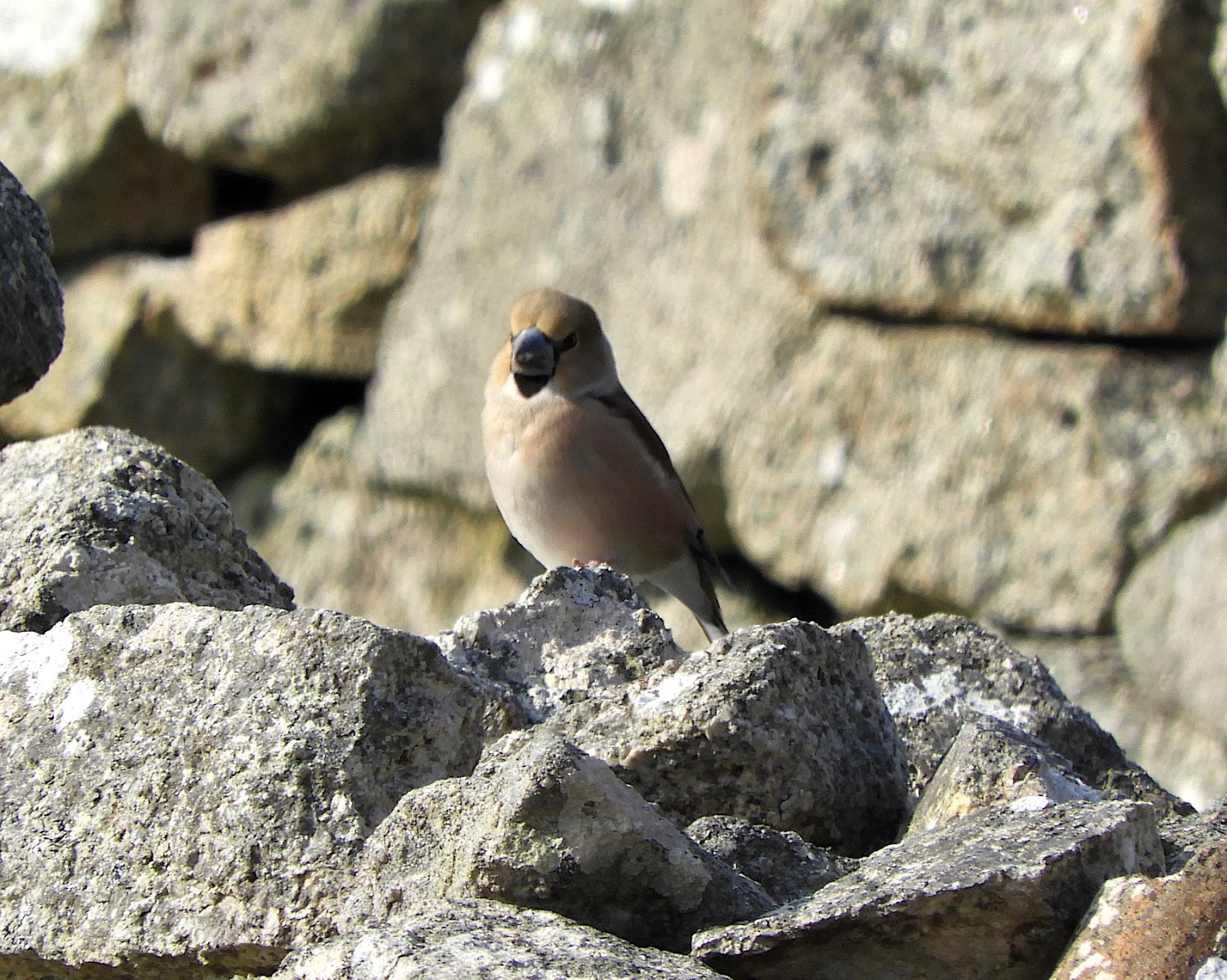
Female Hawfinch, Paradise Row allotments, 16 Apr © Dean Jones

Other birds of note were the first Dunlin of the spring – a total of six birds in two flocks in South West Field. Two more Whimbrel dropped in later in the day, one in Barton Field and the other on Ackland’s Moor. Two more Ring Ouzels were found along the west coast (both males), two fly-over Tree Pipits were also recorded, as well as a decent passage of 143 Linnet throughout the morning – which included a flock of 60 over the Camping Field.

Two of the six Dunlin in South West Field, 16 Apr © Dean Jones

Whimbrel, Barton Field, 16 Apr © Dean Jones

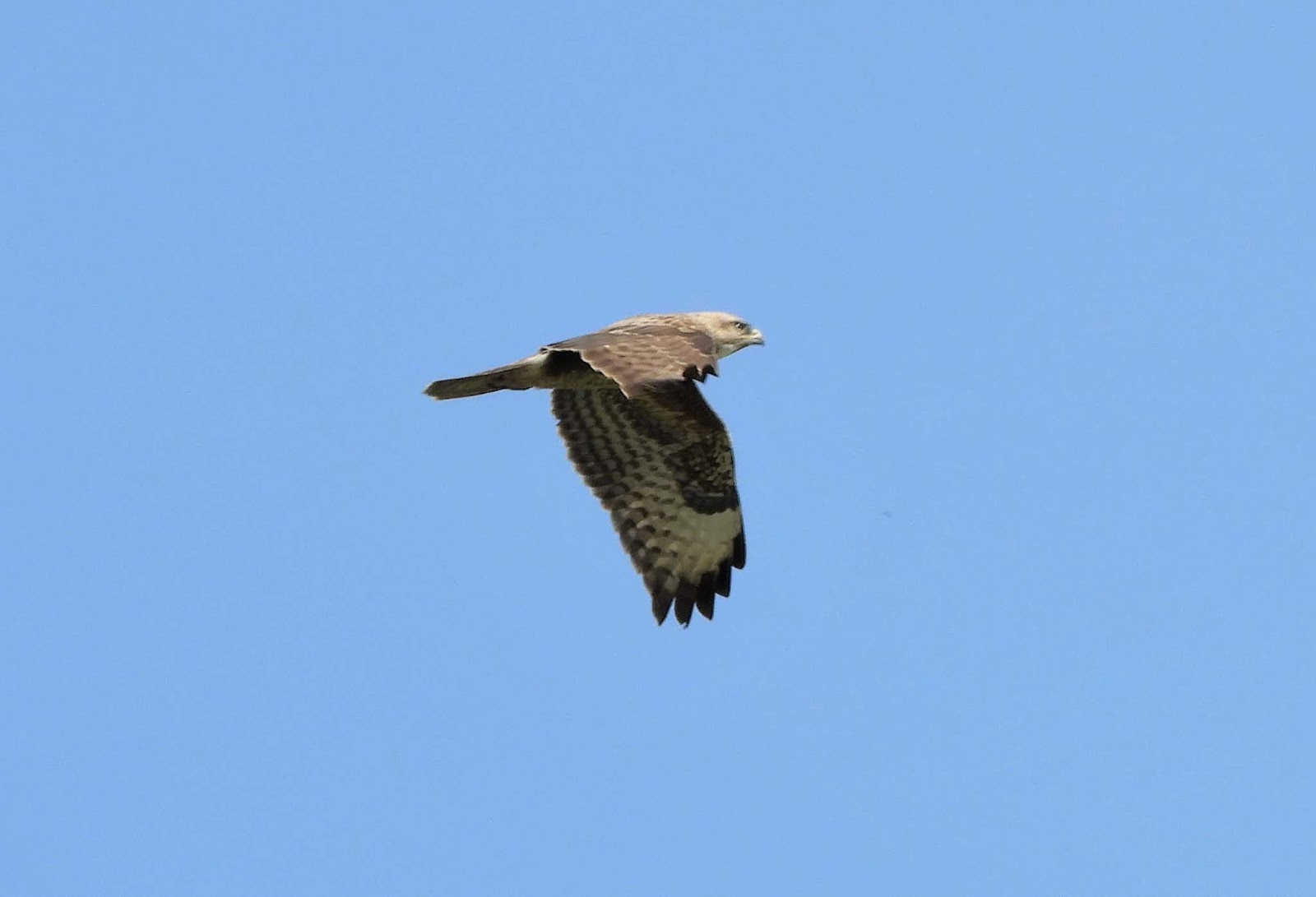
Another run-in that must be mentioned was the surprising occurrence of an escaped Black Kite (sporting jesses, though these are hidden on the photos below) which decided to take a wee rest on the allotment wall outside Paradise Row in the late evening. Despite its captive origin, the kite created much excitement in the Village, with Paradise Row turning into one giant bird hide, most of the Lundy residents enjoying the bird from their kitchen and living room windows!

Black Kite, Paradise Row allotments, 16 Apr © Dean Jones

Black Kite, Paradise Row allotments, 16 Apr © Dean Jones

Other sightings included a lone Sandwich Tern in the Landing Bay, the Quarters Water Rail, a fly-over Ringed Plover, seven Woodpigeon, the female Sparrowhawk still, two Kestrel, a female Merlin, good numbers of auks on ledges, including 89 Puffins in Jenny’s Cove, 37 Swallow, one House Martin, two Sand Martin, a single Whitethroat, 21 Blackcap (quite a few hiding on the West Side from the easterly winds), 24 Willow Warbler, one Chiffchaff, three Goldcrest, 38 Skylark, 10 Pied Wagtail, five White Wagtail in Barton Field, 82 Meadow Pipit, three Dunnock, four Robin, one Stonechat, 45 Wheatear, 11 Blackbird, four Song Thrush, two Chaffinch and 25 Goldfinch.

Sandwich Tern, Landing Bay, 16 Apr © Dean Jones
Female Merlin, main track near Pondsbury, 16 Apr © Dean Jones
Male Blackcap, Battery Slope, 16 Apr © Dean Jones
Resident male Blackbird enjoying the morning sunshine in a shelterd spot in Millcombe, 16 Apr © Dean Jones

Non-avian sightings included another Holly Blue butterfly in Millcombe, the first Small Whites (2) of the year, a Barrel Jellyfish offshore from Miller’s Cake and five Black Oil Beetles on the Castle Parade track.

Monday, 13 April 2020

11th to 13th Apr – Blackcap fall; first Pied Flycatchers & Whitethroat

Saturday 11th April

Another glorious and warm spring day complete with blue skies, minimal wind and a good selection of migrants.

The locals were treated to yet another spectacular sunrise, 11 Apr © Dean Jones

Highlights included a super fall of 110 Blackcap and 53 Willow Warbler – mostly from the south and east coasts of the island. The first two Pied Flycatchers of the year also made an appearance with a female in the Terrace Willows and a lovely male in Millcombe Wood. Another Jackdaw flew over the Villlage in the afternoon and two Grasshopper Warblers were reeling in Millcombe and St Johns first thing along with three nearby Sedge Warblers. The Buzzard remained for another day – seen soaring over High Street Field in the afternoon and seven White Wagtails were foraging in Barton and Brick Fields throughout the day.

One of the first two Pied Flycatchers of 2020 – a female in the Terrace willows, 11 Apr © Dean Jones

One of the 110 Blackcaps logged on 11 Apr © Dean Jones

The Buzzard remained for another day – here over the High Street, 11 Apr © Dean Jones

Other sightings of note from the south and east coasts included the long-staying Great Northern Diver in the Landing Bay first thing, four Woodpigeon, the female Sparrowhawk, two Kestrel together over the Quarries, just one Swallow, two Chiffchaff, one Goldcrest, 19 Skylark, eight Pied Wagtail and another unraced fly-over alba wag, 94 Meadow Pipit (including a flock of 57 birds in Tent Field), three Dunnock, three Robin, two Stonechat, four Wheatear, three each of Blackbird, Redwing and Song Thrush, a single Fieldfare, three Chaffinch, seven Goldfinch and 49 Linnet.

Unfortunately there was no further sign of the Hoopoe from yesterday.

Ringing totals: Blackcap 30, Willow Warbler 17 and Chiffchaff 2.

Non-avian news includes the first Silver Y of the year and two Rabbits in the Upper East Side Path – the first seen in quite some time!

Sunday 12th April

Thick fog for the first few hours, clearing by 10:00am to give way to some more lovely sunshine for most of the rest of the day, other than a few hazy/foggy spells in the afternoon. South and westerly breeze to start, turning easterly again by mid-morning.

A much quieter feel to the island today due to the mass departure of Blackcaps – just eight logged. It was still a very enjoyable day of birding on the island, however, with a Grasshopper Warbler reeling from a fog-cloaked Millcombe during the first few hours. Later in the day two Jackdaws flew over the Village calling loudly (it has been a great spring for records of this scarce corvid this year). A male Common Redstart was catching insects from its Quarter Wall perch and lots of nest-building was observed among the Starlings and Linnets.

Raven on the lookout for a meal at Halfway Wall, 12 Apr © Dean Jones

Other sightings of note included 27 Mallard (23 ducklings in total so far), the long staying Great Northern Diver in the Landing Bay first thing, five Woodpigeon (including a lone bird hiding from the Peregrines at Halfway Wall), two Water Rail, 1,500 Guillemot on ledges in Jenny’s Cove, 400 Razorbill, 68 Puffin, four Swallow, two Sand Martin, 27 Willow Warbler, two Chiffchaff, two Goldcrest, 25 Skylark, six Pied Wagtail, two unraced fly-over alba wags and a lone White Wagtail in Barton Field, 89 Meadow Pipit, seven Dunnock, three Robin, three Stonechat, six Wheatear, ten Blackbird, three Redwing, three Chaffinch, 14 Goldfinch and 39 Linnet.

Easter ducklings – a female Mallard and her brood, St John's Valley, 12 Apr © Dean Jones

Monday 13th April

The shorts, T-shirt and peaked cap were swapped for long trousers and woollies today due to a hefty easterly wind which peaked at gale force around midday. It was very hard going on the birding front, particularly in the morning, as there wasn’t much shelter on the island at all (the wind blew the specs off my face on the west coast path!). Unsurprisingly most of the birds remained very inconspicuous for most of the day – migrants logged included the first Whitethroat of the year in Millcombe, four Willow Warbler, three Blackcap, singles of Chiffchaff, Goldcrest and Redwing, a lone White Wagtail in Barton Field and a small arrival of Goldfinch (24) – which included a flock of 16 underneath Sue Waterfield’s feeder.

Gale-force easterlies made for difficult birding... © Dean Jones

Some of the 24 Goldfinches logged on 13 Apr, underneath Sue Waterfield's feeder © Dean Jones

The latest update from the Landmark Trust concerning the Covid-19 pandemic and Lundy can be found here.

Saturday, 11 April 2020

8th to 10th Apr – Hoopoe tops a superb few days!

Dean Woodfin Jones sums up three wonderful spring days on Lundy. Thank you Dean for enabling the rest of us to experience the island vicariously through your wonderful words and photos during these strange times!

Wednesday 8th April

A cloudy and very still start to the day, becoming very sunny, hazy, warm and slightly breezier from the east in the afternoon.

A truly beautiful spring day today and with the arrival of the pink Super Moon yesterday evening, the island saw one of the lowest tides of the year today, dropping to just 0.18m around midday! The perfect opportunity to get the wellies on and explore the lower shores and to carry out the annual cup coral counts in the Devil’s Kitchen.

A super-low tide caused by a super pink moon! The Jetty and Landing Bay on 8 Apr © Dean Jones

Lundy is one of the best places to see cup corals in the country, be it from the shore at a good low tide, or by diving around the island. In fact Lundy is one of the only places where you can see all five species that occur around the coast of the UK.

Just two of these species occur in the lower littoral of the Devil’s Kitchen, the Scarlet and Gold Cup Coral Balanophyllia regia and the Devonshire Cup Coral Caryophyllia smithii. Surveys have been carried out on Lundy pretty much annually since 1984, providing insights into how healthy these small intertidal colonies are and how they change over the years. Results from today’s survey showed that the total number of coral over the three sites is up on last year, with the team managing to find a total of 199 Scarlet and Gold Cup Corals (177 in 2019) and 9 Devonshire Cup Corals (8 in 2019) – hooray! Only one of the three colonies showed a slight reduction in the number of corals present, but only slightly, and the third site – a much newer site for these amazing Cnidarians – had more than doubled in size, very encouraging stuff.

Scarlet and Gold Cup Coral colony, Devil's Kitchen, 8 Apr © Dean Jones

On top of that the team also saw lots of other amazing marine beasties such as Cornish Suckerfish, Spiny Starfish, thousands of Porcelain Crabs, the rare and unusual hyroid Candelabrum cocksii and a recently deceased Cuckoo Ray which later became lunch for the Rat Island Great Black-backs.

And that's not all! Whilst pottering along the shore within one of the shallow gullies running the length of the Kitchen, keen eyed Rosie Ellis (Education Officer) managed to find another small colony of 21 Scarlet and Gold Cup Corals bringing the total for the day to 220 – bravo Rosie!

Cuckoo Ray Leucoraja naevus, Landing Bay, 8 Apr © Dean Jones

Now onto the birds!

Avian highlights from a morning's birding included a spectacular little fall of Willow Warbler (90) and Blackcap (31) along the south and east coasts of the island. Furthermore, the first Ringed Plover of the year flew over the island calling loudly in the late morning and a gorgeous female Sparrowhawk was watched coming in off the sea from above Benjamin’s Chair.

The female Sparrowhawk that flew in off the sea from the south, 8 Apr © Dean Jones

Other sightings included nine Manx Shearwater foraging off the east coast in the afternoon, the Quarters Water Rail, four Woodpigeon, one Kestrel, 21 Swallow, two Sand Martin, two House Martin, four Chiffchaff, two Goldcrest, 18 Skylark, nine Pied Wagtail and two fly-over alba wags, 12 Dunnock, three Robin, two male Stonechat, six Wheatear, ten Blackbird, four Redwing, two Chaffinch, 16 Goldfinch and 46 Linnet.

Other non-avian highlights include a Holly Blue butterfly on the wing on the Lower East Side Path, as well as a small number of Peacocks in Millcombe.

Thursday  9th April

The day started off with a beautiful sunrise enhanced as its rays reflected off a glass-like sea. Barely a breath of wind blew throughout the day – other than a slight breeze from the east in the afternoon – perfect conditions to encourage migrants to make their way north.

Sunrise over a glass-like sea – looking over Millcombe and the Landing Bay, 9 Apr © Dean Jones

New additions to the year list today included the first Sedge Warbler of the year singing in the Secret Garden first thing. Nearby a Grasshopper Warbler was reeling away in St John’s Valley for most of the morning, and a stunning male Common Redstart was present on the fence in Barton Field.

Male Common Redstart perched on the fence of Barton Field, 9 Apr © Dean Jones

Other than these star birds, Willow Warbler were present again in good numbers with at least 50 birds dotted around the island, as well as a super arrival of Blackcap, with 75 birds logged. Three White Wagtails were also noted from Brick Field and an Icelandic Redwing was hoaking for a meal between the pony apples in Barton Field.

Some of the fall of about 75 Blackcaps, resting incongruously on Barton Field fence! 9 Apr © Dean Jones

Other sightings of note included a Great Northern Diver in the Landing Bay first thing, a Snipe flushed from South West Field, four Woodpigeon, one Kestrel, 14 Swallow, one Sand Martin, three House Martin, seven Chiffchaff, two Goldcrest, 17 Skylark, 80 Starling, three Pied Wagtail and three fly-over alba wags, 76 Meadow Pipit, six Dunnock, three Robin, two Stonechat, 20 Wheatear (including four candidates for the Greenland race leucorhoa), eight Blackbird, four Redwing, three Chaffinch, 16 Goldfinch and 50 Linnet.

Ringing totals (53 birds caught): Blackcap 22, Willow Warbler 23, Chiffchaff 6, Goldcrest 1 and Dunnock 1.

Friday 10th April

Another hazy start to the day becoming lovely and clear in the afternoon – slight to moderate easterlies throughout.

Another fantastic day of Lundy birding! The title of star bird today has to go to the Hoopoe which was initially flushed from the main track next to Pondsbury at around 11:45. From here it showed very well for a few minutes or so before disappearing in the long sward above the Quarries. The bird was then seen again later in the afternoon feeding back along the main track (Rosie Ellis).

Hoopoe, by the main track, near Pondsbury, 10 Apr © Dean Jones

Other highlights included the first Tree Pipit of the year calling from a height over Millcombe first thing. Later on a Common Buzzard was seen being harassed by a pair of Ravens over Quarter Wall. Two stunning male flavissima Yellow Wagtails were also present in High Street Field, another Sandwich Tern was foraging in the Landing Bay during the late afternoon. Finally, a small arrival of three Song Thrush was recorded across the island.

Buzzard being mobbed by one of the resident Ravens over Quarter Wall, 10 Apr © Dean Jones

Male Yellow Wagtail in High Street Field, 10 Apr © Dean Jones

Other sightings from the south and east coasts included the first two broods of Mallard ducklings on Rocket Pole Pond and Barton Pond, four Woodpigeon in Millcombe, one Kestrel, just three Swallow, three Sand Martin, four House Martin, 25 Blackcap, ten Willow Warbler, four Chiffchaff, one Goldcrest, 22 Skylark, five Pied Wagtail and two fly-over alba wags, one White Wagtail in Brick Field, 98 Meadow Pipit (including a flock of 54 in tent field), eight Dunnock, three Robin, one Stonechat, four Wheatear, nine Blackbird, five Redwing, two Chaffinch, ten Goldfinch and 30 Linnet.

Non-avian sightings included the first Large White of the year in Millcombe.

Wednesday, 8 April 2020

6th & 7th April – Hirundines push north, Sandwich Tern & Jack Snipe put in appearances

A further update on the progress of spring migration on Lundy, courtesy of island Warden Dean Woodfin Jones:

Monday 6th April

The gale-force winds continued overnight from the 5th, coupled with periods of heavy rain. Come morning however we were blessed with some more beautiful sunshine and some moderate southerly winds, which encouraged the first decent push of Swallows throughout the day (34) along with a handful of House Martin (8).

Avian highlights also included the first Sandwich Tern of the year – perched on one of the mooring buoys in the Landing Bay. A very handsome male Firecrest was caught and ringed in Millcombe, the male Merlin stayed on for another day, and a White Wagtail was busily feeding in Barton Field in the afternoon.

Summer meets winter... Great Northern Diver and Sandwich Tern in the Landing Bay, 7 Apr © Dean Jones

Other sightings of note included a Great Northern Diver in the Landing Bay, a raft of 31 Manx Shearwater off Rat Island in the early morning, a Sparrowhawk, the Quarters Water Rail again, four Woodpigeon, 30 Skylark, 86 Meadow Pipit, four Pied Wagtail and three fly-over alba wags, five Blackcap, 25 Willow Warbler, seven Chiffchaff, three Goldcrest, six Dunnock, two Robin, two Stonechat, six Wheatear, seven Blackbird, three Chaffinch, 20 Goldfinch and 27 Linnet.

Male Blackcap perched on a rail of the cattle crush at Quarter Wall, 7 Apr © Dean Jones

Ringing totals (retraps in brackets): Chiffchaff 3, Willow Warbler 1, Blackcap 2, Goldcrest 1, the male Firecrest and a Blackbird (1).

Male Firecrest mist-netted in Millcombe on 7 Apr © Dean Jones

Tuesday 7th April

A cool and damp early morning, quickly brightening up, though overcast for part of the afternoon and a light easterly breeze throughout.

Highlights included a Jack Snipe flushed from the side of the track between Rocket Pole Pond and South West Point. The first Collared Dove of the year was also present in Millcombe early on. An adult Mediterranean Gull was foraging offshore from the Landing Bay first thing and there was a beautiful female Black Redstart on the Terrace.

Male Linnet in typical breeding habitat, South West Field, 7 Apr © Dean Jones

The island also saw a decent push of Linnet, with 41 birds counted throughout the day. The glorious settled conditions also allowed for another attempt to get out west and find some more colour-ringed Wheatears. There was quite a lot of activity along the west and south coasts today, with a number of breeding birds seen fighting over territories and lots of unringed migrant birds passing through. All in all we managed four more colour-ringed birds (there were a number of others being cheeky and hiding their rings) and a total Wheatear count of 44.

Colour-ringed (black over white, R leg, metal over stripe L leg) male Wheatear, The Battery, 8 Apr © Dean Jones

Colour-ringed (blue over blue, R leg, metal over striped L leg) female Wheatear, The Battery, 8 Apr © Dean Jones

Other sightings of note included two Cormorant past Pilot's Quay, the Quarters Water Rail again, five Woodpigeon, 55 Puffin in Jenny’s Cove, one Kestrel, 30 Swallow, a lone Sand Martin, three House Martin, 25 Skylark, 80 Meadow Pipit, ten Rock Pipit, two Pied Wagtail, 13 Blackcap, 19 Willow Warbler, two Chiffchaff, six Goldcrest, eight Dunnock, three Robin, two Stonechat, nine Blackbird, five Redwing, three Chaffinch and 17 Goldfinch.

Breeding-plumaged Cormorants flying north past Pilot's Quay, 8 Apr © Dean Jones

Ringing totals: Chiffchaff 1, Willow Warbler 4, Blackcap 4, Goldcrest 1 and Wren 1.

Sunday, 5 April 2020

1st to 5th Apr – An exceptional influx of Jackdaws (and much else besides!)

Wednesday 1st April

The strong north-easterly faded overnight to a breeze come morning. It was still very cold for the first few hours of the day, though a number of sunny spells allowed some relief from the cold.

Not much in the way of visible migration for the first few hours other than a small number of Linnet 38 (including a flock of 17 in the Camping Field) and a small fall of Redwing (11). There was, however, lots of cetacean activity with at least 15 Common Dolphin and five Harbour Porpoise feeding off South West Point at around 7:30am.

Redwing at Jenny's Cove, 1 Apr © Dean Jones

A few more Jackdaw joined the St Helen's Tower gang, reaching 11 birds by the evening. Two Red-throated Diver were foraging together offshore from the Landing Bay first thing and a Great Northern Diver was loafing off the Terrace. This morning also saw the first three-figure Puffin count of the year, with 184 birds on land and on the water between the Battery and Pyramid Slope.
Come the afternoon, the wind dropped away to near nothing, triggering a little flurry of Willow Warbler (11), Chiffchaff (23) and Wheatear (18) – including a few more colour-ringed birds at Quarter Wall.

Chiffchaff at Quarter Wall Pond, 1 Apr © Dean Jones

Willow Warbler on the Terrace, 1 Apr © Dean Jones

Other birds recorded included 21 Manx Shearwater feeding off South West Point this morning, just 15 Fulmar, the Quarters Water Rail, four Woodpigeon, 30 Kittiwake, 877 Razorbill, 1,760 Guillemot (lots of auk activity on the ledges today), 27 Skylark, 98 Meadow Pipit, five Pied Wagtail, two Blackcap, four Goldcrest (including one calling in Jenny’s Cove), 12 Dunnock, seven Robin, two male Stonechat, six Blackbird, four Chaffinch and 13 Goldfinch.

Ringing totals (retraps in brackets): Willow Warbler 8, Chiffchaff 9, Blackcap 2, Wren 1 (1) and Robin (1).

Thursdsay 2nd April

A day of moderate north-westerlies. Overcast in the morning, giving way to beautiful clear skies by the afternoon. Still rather nippy in the wind, particularly in the morning, but much warmer than the past few days.

A beautiful spring day at Quarter Wall Copse, 2 Apr © Dean Jones

Avian highlights today included a spectacular flock of 59 Jackdaws which drifted over the South East Point around 13:00 hrs. From here, the gang moved around the island for a few hours, resting briefly in Barton Field, Millcombe and the Church Tower before heading north and out of sight. This is the highest spring count of this canny corvid for the island, with the previous record being 53 birds on April 25th 1948, and the third-largest all-time count (record 250 birds on 20th October 1983).

Two very handsome male Ring Ouzels – one in Barton Field and one at Quarter Wall – were a very welcome addition to the day list too.

The Arrival –  Jackdaws over South East Point, 2 Apr © Dean Jones

The Arrival – part of the exceptional flock of 59 Jackdaws © Dean Jones

Male Ring Ouzel in Barton Field, 2 Apr © Dean Jones

Other birds along the South End and the Lower East Side Path included a Great Northern Diver (Rosie Ellis), the Quarters Water Rail, four Woodpigeon, 14 Skylark, 47 Meadow Pipit, three Pied Wagtail, eight Blackcap, 16 Chiffchaff, eight Willow Warbler, four Goldcrest, eight Dunnock, four Robin, three Stonechat, two Wheatear, six Blackbird, 16 Redwing, a lone Fieldfare, four Chaffinch, 12 Goldfinch and three Linnet.

Non-avian news: Along the sheltered and sun-kissed east coast this afternoon there was lots of queen bumblebee activity, with at least 30 Buff-tailed Bumblebees, one White-tailed and two Common Carder Bees noted. Butterflies were also on show today, with three Peacocks along the East Side, a Small Tortoiseshell in Millcombe and the first Green-veined White of the spring on the Terrace. Finally, a total of three Barrel Jellyfish were recorded along the east.

Friday 3rd April

A cold and overcast start to the day, coupled with a light south-westerly breeze, becoming warm and sunny by the afternoon.

Despite the better conditions for passage, it was a rather quiet day on the migrant front. A small push of Pied and alba Wagtails (14 birds) was observed first thing, as well as small numbers of Willow Warbler (8) and Chiffchaff (12) in Millcombe. Eleven of the Jackdaws from yesterday – perhaps the original Church Tower gang – were present in Barton Field during the mid-morning. Six Swallows were also recorded making their way north throughout the day, and a female Greenfinch was calling from the Laundry Garden privet in the late afternoon.

Other birds include the Quarters Water Rail, four Woodpigeon, 25 Skylark, 54 Meadow Pipit, two Blackcap, six Goldcrest, five Dunnock, three Robin (including one bird gathering nesting material in Millcombe), three Wheatear, seven Blackbird, two Redwing, four Chaffinch, 14 Goldfinch and six Linnet.

Guillemots, Razorbills & Puffins on their breeding ledges at Jenny's Cove, 1 Apr © Dean Jones

Ringing totals (retraps in brackets): Willow Warbler 4, Chiffchaff 5 (1), Blackcap 1, Goldcrest (1), Wren (1) and a House Sparrow (1).

Saturday 4th April

Sunny spells, prolonged overcast periods and a stiff southerly wind, turning south-easterly by the evening.

Birding highlights from today included a very handsome male Merlin – the first of the spring – hunting Meadow Pipits in Barton Field in the afternoon. Further up the island, a Great Northern Diver was rafting upon the hefty swell offshore from the Terrace. The Church Tower Jackdaws remained on the island for the first few hours of the day before they were seen gaining height and disappearing north over the Village, and a small fall of Phylloscopus warblers was noted, most of which were foraging inconspicuously in some of the more sheltered areas of the island.

A rather worn Peacock basking on the Terrace, 2 Apr © Zoë Barton

Sightings of note included the Quarters Water Rail again, eight Woodpigeon, two Kestrel together over the Terrace, a Sparrowhawk in Millcombe first thing, 17 Swallow, two House Martin over Quarter Wall, a single Sand Martin, 24 Skylark, 40 Meadow Pipit, two Pied Wagtail, three Blackcap, 19 Willow Warbler, 11 Chiffchaff, six Goldcrest, 12 Dunnock, five Robin, five Blackbird, three Chaffinch, 14 Goldfinch and 23 Linnet.

Sunday 5th April

Strong south-easterly winds today picking up to near gale force by the afternoon – lots of sunshine still between bouts of cloud.

A pretty quiet day today on the bird front as the strong winds enveloped the island. However, there were a few nice birds skulking around in the more calm and sheltered pockets, including a handsome male Firecrest in the elder next to the Gas Shed.

Firecrest by the Gas Shed in Millcombe, 5 Apr © Dean Jones

Other sightings included 82 Manx Shearwater past Rat Island in the early morning (30 mins of observations), five Woodpigeon, a female Kestrel being mobbed by two Peregrine on the East Side, just five Swallow, 27 Skylark, 29 Meadow Pipit, two Pied Wagtail, three Blackcap, 12 Willow Warbler, five Chiffchaff, five Goldcrest, eight Dunnock, five Robin, four Blackbird, three Chaffinch (including one female collecting sheep’s wool in Millcombe for her nest), 16 Goldfinch and 26 Linnet.

Wednesday, 1 April 2020

30th & 31st Mar – More Jackdaws and an unlucky Woodcock

Dean Jones provides an end-of-month update on the latest avian and other goings-on on Lundy...

March 30th

Another chilly but sunny start to the day, becoming cloudy by the mid-afternoon – strong north-easterlies throughout much of the morning which slackened off significantly by early afternoon.

Due to the less than desirable birding conditions for most, the day was spent ticking off jobs on the to-do list. These included taking willow cuttings to plant and bulk out the St John’s Valley bird-ringing site, tidying up the Millcombe Valley tree nursery (lots of mulch mats flapping around in the wind) and completing this month’s rodent bait station checks.

Although the chances of a rat or mouse managing to reach Lundy now is very slim with the island being closed to visitors, it is still very important to check each box thoroughly every month – particularly for rats which are very good swimmers – to ensure none have made it to the island from any of the passing ships. There are 70 stations dotted across the island, each of which houses a little block of either chocolate or peanut butter flavoured wax designed to entice any rodent to go into the station and leave its tell-tale teeth marks and droppings. If a box does house signs of a rat or mouse, it allows us to pinpoint the rough area of incursion and catch any possible harmful rodents before they breed and spread across the island and predate any young seabirds, such as Puffins, or ground-nesting birds. Luckily for us and the birds, there were no signs of any rats or mice on the island today, rather a few little droppings deposited in a few boxes by our endearing native Pygmy Shrews.

The Warden checking a rodent monitoring station at the South Light – one of the 70 around the island © Zoë Barton

Avian highlights from this beautiful spring day included a Red-throated Diver and a Great Northern Diver close into the Landing Bay in the morning, a flock of 14 Jackdaw which parachuted into the Tent/Helicopter Field in mid-afternoon and two Common Gull feeding offshore from Rat Island. Note: The Jackdaw flock is highest count since a record-breaking 31 arrived on 18 Oct 2007.

The Jackdaw flock in the Tent/Helicopter Field, 30th Mar © Dean Jones

Other birds of note included the Quarters Water Rail, eight Woodpigeon in Barton Field, the male Sparrowhawk again in Millcombe, two more colour-ringed Wheatear at the Castle, two Stonechat, 20 Skylark, 81 Meadow Pipit, seven Pied Wagtail, three Chiffchaff, one Blackcap, only one Goldcrest, three Song Thrush, five Chaffinch, 15 Goldfinch and 10 Linnet.

Non-avian news included a Barrel Jellyfish in the Landing Bay and four Black Oil Beetles on Lametor.

Black Oil Beetle on track next to South Light, 30th Mar © Dean Jones

March 31st

Blustery north-easterlies with sunny spells again this morning gave way to clear skies and a breeze by the late afternoon.

Despite their being an obvious lack of birds on the plateau first thing, the morning took an interesting turn once I realised that seven of the nine Highland Cattle had broken through Quarter Wall fence and were making their way along the Upper East Side Path. After cutting off their route just before the northern border of Barton Field – I managed to rustle the herd back in the direction of Quarter Wall.

From here, as the hairy beasts made their way back along the path above White Beach, the leading steer flushed a Woodcock from the undergrowth which subsequently made a beeline for cover further south. However this didn’t go unnoticed and as soon as the bird flushed, a female Peregrine, which had been hanging in the wind, swooped down and gave chase. After a couple of seconds of spectacular aerial manoeuvring, the Peregrine closed in and managed to catch the Woodcock just a few metres away from where I was standing. Although I felt bad for the poor Woodcock which had just become the Peregrine's breakfast – thanks to the pesky cattle – I also felt blessed to have witnessed the island’s top predator in action. What a bird!

The gang reunited! 31st Mar © Dean Jones

Other avian highlights from the day included another Red-throated Diver off Rat Island, a different bird from the one seen yesterday based on the extent of its breeding plumage, seven Jackdaw in High Street Field and a 3rd-calendar-year Mediterranean Gull and eight Common Gull foraging in the Southern Races.

Further sightings of note were three Teal on Pondsbury, the Quarters Water Rail, the male Sparrowhawk again in Millcombe, nine Puffin on the water in Jenny’s Cove, 134 Guillemot on ledges and 304 Razorbill mostly offshore, eleven Wheatear, two Stonechat, 34 Skylark, 81 Meadow Pipit, three Pied Wagtail, one Chiffchaff below Benjamin’s Chair, one Song Thrush, six Chaffinch, seven Goldfinch and 16 Linnet.

Non-avian sightings included a single Harbour Porpoise off Rat Island.

Jackdaws, a Carrion Crow and Starlings enjoying the evening sun on St Helen's Church, 31st Mar © Dean Jones
Sika Deer in South West Field trying to shelter from the north-east winds, 31st Mar © Dean Jones

Please note that the Landmark Trust has updated its advice regarding the Covid-19 outbreak. The latest statement, dated 30 March, can be found here.